What is D-Day? How the Normandy landings led to Germany’s defeat in World War II
Friday marks 81 years since D-Day, the first day of the Normandy landings that laid the foundations for the Allied defeat of Nazi Germany in World War II.
On this episode, Dr. Joel Myers shares the untold story behind D-Day, which is commemorating its 81st anniversary on June 6. Take a look at how weather played a role in the invasion of Normandy.
(CNN) — Friday marks 81 years since D-Day, the first day of the Normandy landings that laid the foundations for the Allied defeat of Nazi Germany in World War II.
The invasion – codenamed Operation Overlord – saw of tens of thousands of troops from countries including the United States, the United Kingdom and Canada landing on five stretches of the coastline of Normandy, France – codenamed Utah, Omaha, Gold, Juno and Sword beaches.
Planning for D-Day began more than a year in advance, and the Allies carried out substantial military deception to confuse the Germans as to when and where the invasion would take place.
When was D-Day?
The operation was originally scheduled to begin on June 5, 1944, when a full moon and low tides were expected to coincide with good weather, but storms forced a 24-hour delay. Allied divisions began landing on the five beaches at 6:30 a.m. on June 6.
What does D-Day stand for?
The term ‘D-Day’ was military code for the beginning of an important operation, with the first ‘D’ being short for ‘Day.’ This means that D-Day actually stands for ‘Day-Day.’
According to the Royal British Legion, the phrase ‘D-Day’ was used fairly often before the Allied invasion in June 1944. After this, however, the two became synonymous, and now D-Day is commonly understood to refer to the beginning of Operation Overlord.
Which Allied countries were involved?
D-Day saw unprecedented cooperation between international armed forces, with more than 2 million troops in the UK in preparation for the invasion, according to the Imperial War Museums (IWM).
Most of these troops were American, British and Canadian, the IWM reports, but troops also came from Australia, Belgium, the Czech Republic, France, Greece, the Netherlands, New Zealand, Norway, Rhodesia (now Zimbabwe) and Poland to participate in Operation Overlord.
What preparations were made?
The Allied troops’ invasion was coordinated across air, land and sea, in what can be described as amphibious landings.
These were preceded by an extensive bombing campaign to damage German defenses, as well as the employment of deception tactics.
Operation Bodyguard was an umbrella term for the deception strategy leading up to the Allies’ invasion of Europe in June 1944. Operation Fortitude was a tactic under this umbrella specifically related to the Normandy invasion, and was intended to make Nazi Germany believe that the initial Normandy attacks were merely a diversion and that the true invasion would take place elsewhere.
According to the IWM, Fortitude North intended to trick the Germans into believing that the Allies would attack Norway, and Fortitude South was designed to convince the Germans that the Allies were going to invade Pas de Calais, a French department northeast of Normandy that is closer to the UK.
What happened on D-Day?

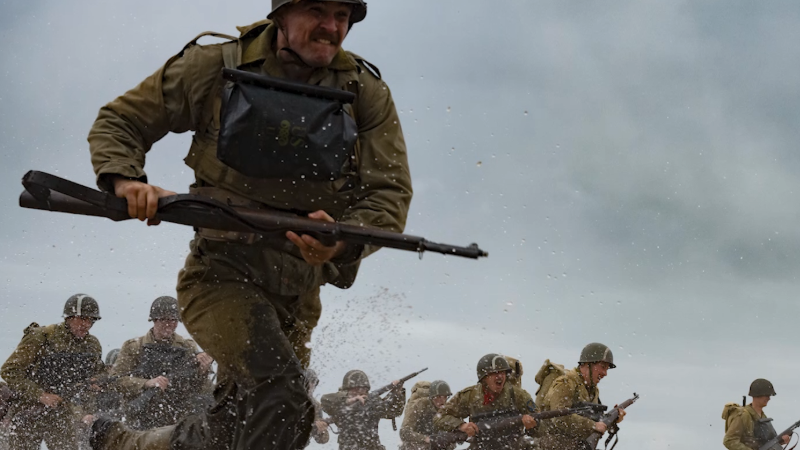
June 6, 2025 marks 81 years since D-Day, the first day of the Normandy landings that laid the foundations for the Allied defeat of Nazi Germany in World War II. (Photo credit: Getty Images via CNN Newsource)
The US troops were assigned to Utah beach at the base of the Cotentin Peninsular and Omaha Beach at the northern end of the Normandy coast. The British subsequently landed on Gold Beach, followed by the Canadians at Juno, and finally the British at Sword, the easternmost point of the invasion.
By midnight, the troops had secured their beachheads and moved further inland from Utah, Gold, Juno and Sword.
However, not all the landings were successful; US forces suffered substantial losses at Omaha Beach, where strong currents forced many landing craft away from their intended positions, delaying and hampering the invasion strategy.
Heavy fire from German positions on the steep cliffs, which had not been effectively destroyed by Allied bombing before the invasion, also caused casualties.
How did the Germans try to defend themselves?
According to the IWM, Germany’s reaction to Operation Overlord was “slow and confused.”
Weather conditions on June 6 were still poor, many senior commanders were not at their posts, and Operation Fortitude convinced Adolf Hitler that the Normandy invasion was a feint before a bigger attack at Pas de Calais.
Germany’s air force was in action elsewhere, countering American bombing operations over Germany. Its navy ships were docked in ports or already destroyed by the Allies. This left only the German army to defend against Operation Overlord, according to the IWM.
On top of this, the success of Operation Fortitude meant that many army units were kept away from the Normandy battlefield until July, as an attack in Pas de Calais was still expected.
German troops manning coastal defenses “did as much as they could have been expected to,” the IWM says, before eventually being “silenced” and Allied units advanced inland.
How many people died on D-Day?
On D-Day alone, around 4,440 Allied troops were confirmed dead, according to the Commonwealth War Graves Commission (CWGC), with more than 5,800 troops wounded or missing.
Because Omaha Beach was the bloodiest landing beach, the US Army lost the most men in the amphibious landings. Some 2,500 American troops died in the beach assault and airborne operations on D-Day, according to the CWGC.
The precise number of German casualties on the day is unknown, but they are estimated to be between 4,000 and 9,000.
Who were the Bedford Boys?
Of the tens of thousands of troops that stormed the beaches of Normandy on D-Day, 44 were soldiers, sailors and airmen from Bedford, Virginia, in the US.
Within minutes of reaching Omaha Beach, 16 of these men were killed and four were wounded. Another Bedford soldier was killed elsewhere on Omaha Beach, and three others were presumed killed in action, bringing Bedford’s D-Day fatality figure to 20 men.
According to the National D-Day Memorial Foundation, Bedford suffered the highest known per capita D-Day loss in the US.
What followed D-Day?
Despite securing a stronghold on the French coast on D-Day, the Allied forces faced the risk that German bombardment could push them back into the sea.
They needed to build up troop numbers and equipment in Normandy faster than the Germans, allowing for a continued invasion into mainland Europe.
The Allies used their air power to slow the German advance toward Normandy by blowing up bridges, railways and roads across the region. This allowed the Allies to gain total control of Normandy 77 days later and move on toward Paris, which they liberated in August 1944.
What impact did the operation have on the war?
The US Department of Defense calls D-Day the “successful beginning of the end of Hitler’s tyrannical regime.” The IWM calls it the “most significant victory of the Western Allies in the Second World War.”
By being able to get forces into Normandy, the Allies were able to begin their advance into northwest Europe. Though World War II lasted nearly another year in Europe, the success of Operation Overlord led to the liberation of France and allowed the Allies to fight the Germans in Nazi-occupied Europe.
The US’ National World War II Museum says that a good way to appreciate the significance of D-Day is to imagine what would have happened if the operation had failed. According to the museum, another landing would have not been possible for at least a year.
In this time, Hitler could have strengthened Nazi-occupied Europe’s coastal defenses, developed aircraft and weapons, bombed the UK even more heavily and continued his killing campaign, the museum says.
Fighting by the Allies on the western front and Russian soldiers on the eastern front eventually led to the defeat of the German Nazi forces.
On May 7, 1945, the German Third Reich signed an unconditional surrender at Reims, France. Victory in Europe (V-E) Day is celebrated the following day as that’s when the armistice went into effect.
The-CNN-Wire™ & © 2025 Cable News Network, Inc., a Warner Bros. Discovery Company. All rights reserved.
Report a Typo