Lala sweeps away 100 homes in Hawaii after brushing Big Island as a hurricane
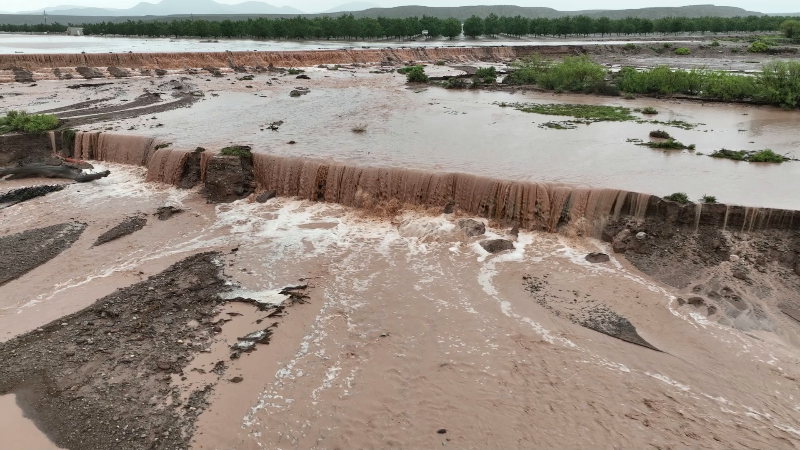
Flash flooding swept homes off their foundations on the Big Island, prompting a search and rescue late Saturday. Two-day rain totals surpassed 3.5 feet in some locations.
Hurricane Lala caused major flooding and mudslides in Hawaii, washing out bridges and cutting off communities. Storm chaser Aaron Rigsby reports.
Hawaii felt the extreme impacts of Tropical Storm Lala after the storm brushed the Big Island as a hurricane Saturday, leaving thousands without power and sweeping away at least 100 homes.
Lala formed into a tropical storm early Thursday southeast of Hawaii and continued to strengthen, becoming a Category 1 hurricane early Saturday with sustained winds of 75 mph. Lala was downgraded to a tropical storm early Sunday.
As Lala made its closest pass, Hawaii County was under a hurricane warning with hurricane-force winds felt across the Big Island. The last time a hurricane watch or warning was issued for the islands was during Hurricane Douglas in 2020.

A view of the rising water levels at the Wainaku Street Bridge in Hilo on the Big Island of Hawaii, Saturday, Aug. 15, 2026. (Taylor Cozloff/Civil Beat via AP)
[See the track, impacts and latest AccuWeather forecast on Lala here.]
Lala prompted a “Particularly Dangerous Situation" warning from the National Weather Service late Saturday, as a flash flood emergency unfolded on Hawaii Island.
At least one person was killed in a storm-related crash, according to Gov. Josh Green. However, as of Sunday, no other deaths were reported from Lala's impacts. Still, the storm caused devastating losses across the islands.
"We lost over 100 homes on the Big Island; several of the bridges are badly damaged," Green said Sunday.
All schools are closed Monday. Naalehu and Pahala schools suffered some of the worst damage. Naalehu Elementary School will remain closed until at least Thursday.
AccuWeather Storm Chaser Aaron Rigsby was about 1 mile from Pahala where flash flooding and debris flows cut off both directions on Highway 11.
"Trees, whole trees, bridges, roadways have completely been blown out by the incredible power of this flash flood," Rigsby said.
More than 3.5 feet of rain falls as outages spread across Hawaii

A vehicle approaches a downed utility pole dangling above Mamalahoa Highway during Hurricane Lala near Ocean View, Hawaii, Saturday, Aug. 15, 2026. (Photo by Stephen Lam/San Francisco Chronicle via Getty Images)
AccuWeather hurricane experts forecast more than 3 feet of rain on the Big Island, a threshold that was exceeded in several locations.
The highest 48-hour rainfall totals topped 3.5 feet on the Big Island, including 43.54 inches at Laupahoehoe, with more than 37 inches at Nahuku and Nene Cabin; Maui’s highest total was 23.17 inches at Waikamoi.

Top rain totals in Hawaii from Lala.
Through the weekend, Hawaii Department of Transportation crews responded to blocked roads on Hawaii Island, Maui and Oahu as Lala's powerful winds knocked down trees and power poles.
During the peak impacts, about 250,000 homes and businesses were without power across Hawaii Sunday as Lala’s winds spread westward across the island chain, according to PowerOutage.us. On Monday, more than 114,000 households and businesses are still without power.

Debris and trees down on Route 210 on Hawaii Island from Hurricane Lala's winds on Aug. 15, 2026. (Image credit: Hawaii DOT)
A 140-mph gust was reported at Mauna Kea Summit around noon. A 74-mph gust was recorded in Olowalu, Maui.
Hawaii Electric officials said they prepared for Lala ahead of the storm's arrival. The provider said more than 500 employees, contractors and support workers were positioned across the state to help with power restoration efforts following the storm.
Coastal areas also faced a threat from Lala. Swells generated by Lala reached east-facing shores Friday before spreading west and building through the weekend, producing life-threatening surf and rip currents. On Saturday, as Lala skimmed past the islands, big waves pounded the east-facing shores with heights nearing 20 feet. The highest surf is forecast from Upolu Point in North Kohala to South Point in Kaʻū.
Lala arrived as the Big Island was already dealing with other natural hazards.
Lava fountains reached heights of 80-100 feet above Kilauea’s summit in Hawaii on Aug. 12. Footage shared by the USGS shows the eruption during the day and at night inside Halemaʻumaʻu crater.
The Daniel K. Inouye Highway, also known as Saddle Road, reopened between Old Saddle Road and Highway 190 on Friday. Crews were battling a wildfire that started Tuesday in South Kohala, leading to the temporary closure. The fire had burned about 230 acres and was 60% contained as of Wednesday, with crews from Hawaii County, the state Division of Forestry and Wildlife, Pohakuloa Training Area and the Hawaii Army National Guard involved in the response.
Kilauea also produced its 53rd eruptive episode of the ongoing summit eruption Wednesday afternoon into early Thursday. The episode began at 3:45 p.m. HST Wednesday and ended at 1:23 a.m. Thursday after 9.6 hours of lava fountaining. Fountains reached approximately 500 feet above the ground while the volcanic plume climbed to about 18,000 feet above sea level. The U.S. Geological Survey said another lava-fountaining episode is likely.
Hawaii Volcanoes National Park closed most areas to the public beginning Friday at noon ahead of Lala's arrival.
Hawaii’s Big Island has never had a hurricane landfall
Lala passed just south of the Big Island Saturday night. If Lala had made landfall, it would have been the first-known hurricane landfall there in the modern historical record, according to AccuWeather hurricane experts.

Tropical cyclone landfalls on the Big Island are rare. Tropical Storm Iselle crossed the Kaʻū coast near Pahala in August 2014 after weakening from a hurricane shortly before reaching the island. Tropical Storm Darby made landfall near Pahala in July 2016 before crossing the southern half of the island.
The island’s towering terrain can disrupt the circulation of approaching tropical cyclones. Both Iselle and Darby weakened or became significantly disrupted as they encountered the Big Island’s mountainous terrain.
Still, a tropical storm or hurricane does not need to make landfall to produce dangerous impacts.
Hurricane Hone passed about 50 miles south of the Big Island in August 2024, bringing heavy rain and tropical-storm-force winds to parts of the island. Hone’s center made its closest approach about 45 nautical miles south of South Point while the storm was strengthening into a Category 1 hurricane.
Report a Typo