Historical Weather Data vs. Real-Time Forecasts
Businesses that rely on weather intelligence need both historical weather data and real-time weather forecasts to make confident decisions.
>>Learn more about AccuWeather For Business

Part of Centennial Christian Church in St. Louis, Missouri, collapsed on Friday, May 16, 2025 when severe storms, including a possible tornado, swept through the city. (AP Photo/Michael Phillis)
Executive Summary
Historical weather data and real-time weather forecasts serve different but equally important business purposes. Historical data explains past performance and identifies long-term weather trends, while real-time forecasts help organizations make informed operational decisions before weather impacts occur. Together, they provide a complete decision-making framework that improves planning, reduces risk, and strengthens business performance across industries.
Key Takeaways
-- Historical weather data provides context for analyzing business performance and identifying long-term trends.
-- Real-time forecasts support proactive operational decisions before weather impacts occur.
-- Combining historical and forecast data improves planning, risk management, and operational efficiency.
-- Businesses across retail, energy, manufacturing, insurance, and transportation benefit from weather-informed decision-making.
-- More accurate weather intelligence can reduce costs, improve resource allocation, and increase operational resilience.
Businesses that rely on weather intelligence need both historical weather data and real-time weather forecasts to make confident decisions. Historical records explain how weather affected previous operations, while continuously updated forecasts help organizations prepare for changing conditions. Together, these insights allow businesses to improve planning, reduce disruptions, and respond with greater confidence.
>> AccuWeather SkyGuard® Severe Weather Warnings better protect people and property when severe weather threatens. Each warning is communicated instantly with AccuWeather’s proven Superior Accuracy™ through multiple channels and dissemination methods, all customized to your specific needs. >>

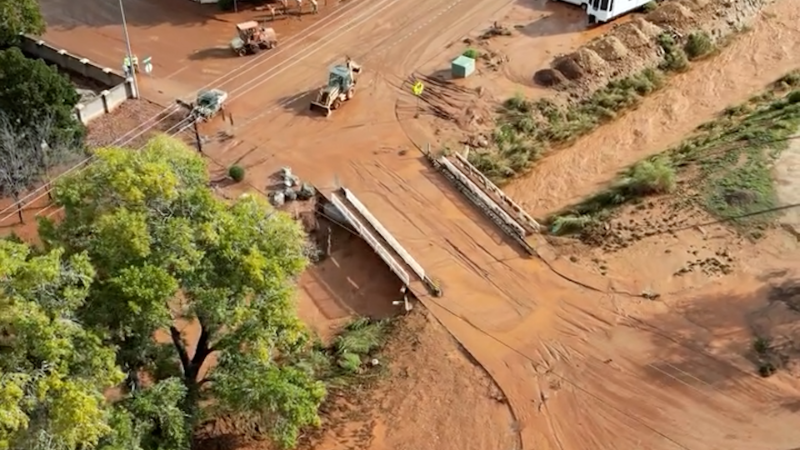
A flood gauge marks the height of water flowing over a farm-to-market road near Kerrville, Texas, on Friday, July 4, 2025. (AP Photo/Eric Gay)
AccuWeather combines more than 60 years of historical weather data with live conditions and forecasts powered by Superior Accuracy™. This unified approach helps organizations compare seasonal performance, identify weather-driven business trends, anticipate supply chain challenges, and separate weather-related impacts from operational factors. The result is more informed decision-making supported by one trusted weather intelligence platform.
Retailers use historical weather patterns alongside localized forecasts with 1-kilometer spatial resolution and more than 300 weather parameters to improve inventory planning, staffing, promotions, shipping, and store operations. By understanding how weather influences consumer demand, businesses can reduce excess inventory, minimize markdowns, and better align resources with expected buying behavior.
Energy providers use historical weather trends to improve load forecasting and renewable energy planning while relying on real-time severe weather forecasts to mobilize crews, protect infrastructure, and accelerate power restoration. Manufacturing organizations analyze historical weather events that contributed to previous disruptions and combine those insights with more accurate severe weather forecasts to reduce unnecessary production stoppages and maintain operational efficiency.
Insurance companies use historical storm records together with highly accurate hurricane forecasts to strengthen catastrophe planning, assess exposure, and prepare claims operations before storms arrive. Transportation and logistics organizations rely on real-time weather warnings to reroute shipments, protect employees, and maintain service while using historical weather patterns to optimize routes and schedules around recurring seasonal risks.
Organizations that combine historical weather data with real-time forecasts gain a clearer understanding of both past performance and future risk. This integrated approach supports better planning, stronger business continuity, improved operational efficiency, and faster responses to changing weather conditions across every stage of the decision-making process.
Action Steps
-- Evaluate how weather has influenced past business performance using historical weather data.
-- Integrate real-time weather forecasts into daily operational planning and decision-making.
-- Use historical weather trends to improve forecasting for inventory, staffing, logistics, and resource allocation.
-- Establish weather-triggered operational plans that activate before high-impact conditions develop.
-- Partner with a weather intelligence provider that delivers both long-term historical data and highly accurate real-time forecasts from a single platform.
AccuWeather’s SkyGuard® Severe Weather Warnings
Be proactive with AccuWeather SkyGuard® Severe Weather Warnings with proven Superior Accuracy™ AccuWeather’s SkyGuard warnings deliver hyperlocal, site-specific alerts and warnings with often more advance notice, before severe weather hits, giving you more time to prepare.
As an example of AccuWeather’s proven Superior Accuracy™, for tornadoes, on average, AccuWeather provides 16 minutes of advance notice compared to an average of only eight minutes from the National Weather Service. In some cases, we often provide much more advance notice.
Businesses that invest in AccuWeather’s SkyGuard Severe Weather Warnings also get access to a team of expert severe weather meteorologists, 24x7x365. AccuWeather does not just send you a warning; we confirm that you have received it, so you can make the best weather-impacted decisions for your business every time.
<<Why take unnecessary risks? Contact AccuWeather today to get AccuWeather's SkyGuard® Severe Weather Warnings to better prepare your business and keep your employees safer for all severe weather threats.>>
Report a Typo