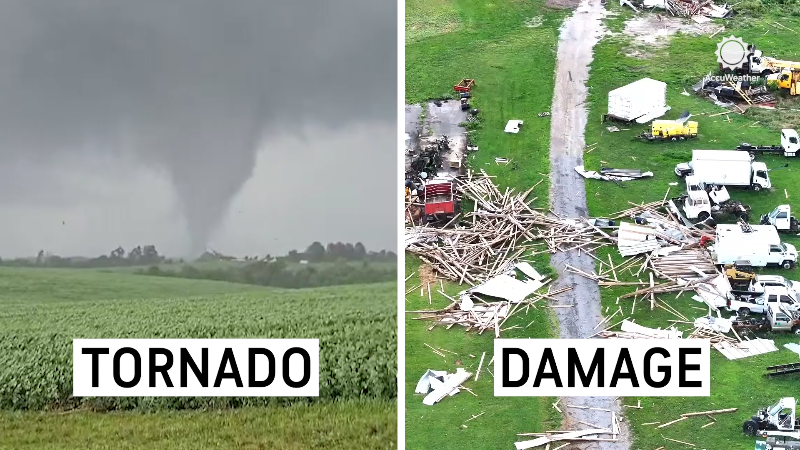
Multiday severe weather outbreak to progress from Plains to Midwest
A dangerous multiday severe weather outbreak will put more than 200 million people at risk of tornadoes, destructive winds, large hail and flash flooding in the central United States through Thursday.
Powerful winds from a severe thunderstorm swept across New York City on Saturday, June 6, sending coolers, cushions and other loose items flying across a rooftop bar in Brooklyn.
Approximately 200 million people will be at risk of severe weather on Wednesday and Thursday as dangerous thunderstorms track eastward.
"All modes of severe weather are possible through Thursday, both day and night, from the Rockies to the Appalachians, including damaging wind gusts, tornadoes, large hail and flash flooding," AccuWeather Senior Meteorologist Brett Anderson said.

AccuWeather’s severe weather classification is impact-driven and differs from the Storm Prediction Center’s system, with a focus on clarity for the general public.
Here's a day-by-day breakdown of the severe weather threat.
Storms to shift east, threaten Minneapolis and Chicago on Wednesday
Severe weather will shift eastward on Wednesday and continue through Wednesday night. At least some risk of severe thunderstorms will extend from much of southwestern Ontario to south-central Kansas.
A broad zone of heightened severe weather risk is forecast across all of Wisconsin, much of Minnesota, northern Illinois, eastern Iowa and part of Michigan's Upper Peninsula. Major cities at risk for severe thunderstorms and significant travel delays include Minneapolis, Chicago, Milwaukee, Kansas City, Missouri, and Des Moines, Iowa.

"Thunderstorms in parts of this zone are likely to persist through Wednesday night," AccuWeather Lead Long-Range Meteorologist Paul Pastelok said.
A high risk of severe weather has been issued for eastern portions of Iowa, northwestern Illinois and southwestern Wisconsin. In this zone, there may be several rounds of severe thunderstorms between midday Wednesday and Wednesday night.
Thursday storms to rumble from Oklahoma to Michigan
The severe weather threat will continue shifting eastward and southward on Thursday and Thursday night, extending from central Ontario to central Oklahoma. The worst of the severe thunderstorms is expected from western Michigan to eastern Kansas with a high-risk area where numerous severe storms are likely to bring high wind gusts centered from northern Illinois and southeastern Wisconsin to southwestern Michigan.

Chicago and Milwaukee are in the high-risk zone. Severe weather is forecast to reach Detroit, Indianapolis and St. Louis, as well as Tulsa, Oklahoma, and Wichita, Kansas.
East faces days of strong storms
Farther east on Wednesday and Thursday, a separate pocket of severe weather is likely in parts of the Northeast.
Some severe storms are anticipated on Wednesday afternoon and evening, centered on the Interstate 81 corridor and along part of I-95 from Baltimore to near Raleigh, North Carolina. The main emphasis will be on torrential downpours and gusty winds.

Some severe storms on Thursday will occur in the zone from southern New Hampshire and eastern Massachusetts to part of northern North Carolina, with the main hazards being torrential downpours and locally damaging wind gusts.

On Friday, the same storm responsible for the severe weather in the Midwest will reach into the eastern parts of the Ohio Valley and Great Lakes, as well as a portion of the Appalachians. Along with torrential downpours and strong wind gusts, some storms may also produce hail.

Weekend to bring renewed risk in the Plains
On Saturday, severe weather is forecast to return to parts of the Plains, although thunderstorms may be less widespread and intense than earlier in the week.

A risk of severe weather is forecast across much of Kansas and Iowa, as well as large parts of Nebraska, Missouri and northern Oklahoma.


Want next-level safety, ad-free? Unlock advanced, hyperlocal severe weather alerts when you subscribe to Premium+ on the AccuWeather app. AccuWeather Alerts™ are prompted by our expert meteorologists who monitor and analyze dangerous weather risks 24/7 to keep you and your family safer.
Report a Typo