The water cycle you learned about in school is off balance. The consequences affect everyone on Earth
The global water cycle is increasingly erratic, bringing dangers including wild swings between floods and drought, according to a new WMO analysis.

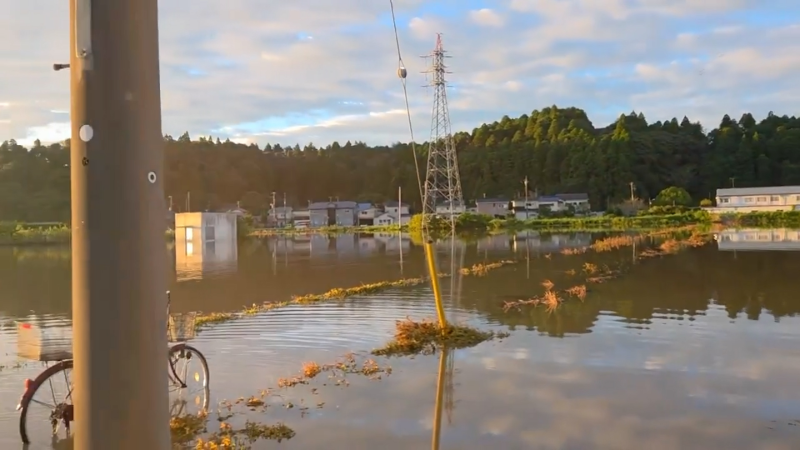
A flooded street following Hurricane Melissa in Petit-Goave, southwest of Port-au-Prince, Haiti, on October 30, 2025. (Photo Credit: Clarens Siffroy/AFP/Getty Images via CNN Newsource)
(CNN) — The water cycle you were taught in school is being thrown off balance by fossil fuel pollution, bringing a host of dangerous consequences including shrinking rivers, disappearing glaciers and wild swings between floods and drought, according to the World Meteorological Organization’s annual analysis of global freshwater.
The water cycle refers to the complex system by which water moves around the Earth. It evaporates from the ground — including from lakes and rivers — and rises into the atmosphere, forming large streams of water vapor able to travel long distances, before eventually falling back down to Earth as rain or snow.
This cycle is becoming “more erratic and unpredictable,” warns the WMO’s State of Global Water Resources Report published Thursday, which covers 2025, one of the planet’s warmest years on record.
☔️ Get your forecast in the CNN Weather app
The total amount of freshwater stored in the Earth’s rivers, lakes, aquifers, ice, snow and soils is in decline, the report found using satellite data. In 2025, 42% of the world had storage levels below historical norms.
“The direction is clear: Water stored on land has been declining globally since around 2016,” said Wayne Jenkinson, the WMO’s director of hydrology and cryosphere.
Last year was one of the driest for the globe’s rivers in the past 35 years, with affected areas including much of North America, parts of South America, Eastern Europe, the Middle East and Central Asia.
Rivers are vital trade arteries, sources of water for people, farms and industry, electricity producers, wildlife habitats and tourist draws.
The planet has now experienced seven years of abnormal river flows. While some rivers saw above average flows in 2025 — including in parts of South and South East Asia and Australia — a greater percentage were below average, according to the report.
It’s a similar story for the world’s groundwater. Two-thirds of monitored wells experienced conditions outside the historical norms last year, with the balance shifting further toward deficit compared to 2024.
The world’s frozen regions also experienced concerning shifts. All regions experienced widespread glacier loss in 2025, for the fourth year straight. Between 2023 and 2025, glaciers lost enough water to fill about 560 million Olympic-sized swimming pools, the report calculated.
Melting glaciers bring hazards like floods and rising sea levels, as well as the risk of water insecurity for the two billion people who rely on them.
Glaciers, snow and ice form the slow part of the water cycle, as compared to faster parts like rivers and lakes, accumulating and depleting over longer periods.
“Traditionally these slow reserves have acted as the planet’s savings account: a buffer that absorbs bad years so that a single drought or a single dry season does not translate directly into a water crisis,” said WMO Secretary-General Celeste Saulo. “We are depleting that savings account.”
As the water cycle shifts, the weather is becoming more extreme. The past five years have all seen record-breaking floods and droughts, with some places having little time to recover between one extreme event and the next, the report found.

Electrical poles are down in the neighborhood of North Street following Hurricane Melissa, in Black River, Jamaica, on October 29, 2025. (Photo Credit: Ricardo Makyn/AFP/Getty Images via CNN Newsource)
Asia and Africa were the most affected regions, in terms of number of events and lives lost. Countries including Nigeria and the Democratic Republic of Congo experienced major flooding, and parts of South and Southeast Asia were hit by tropical cyclones and intense monsoon rains last year.
In the US, catastrophic flooding in the Texas Hill Country in July 2025 killed more than 130 people and in the Caribbean, Hurricane Melissa tore across islands including Jamaica and Haiti, killing more than 90 people.
At the opposite end of the spectrum, parts of Eastern Europe, the Mediterranean and the Middle East endured severe drought.
This year could see even more extremes, the report warned. “The strengthening El Niño will increase the risk of drought in some areas, and flooding in others,” Saulo said.
The report drew on water information from more than 60 countries but the authors note that there are still critical data gaps, often from regions where extremes are most severe, including Asia and Africa. It’s critical to close these gaps as “we cannot manage what we do not measure,” Jenkinson said.
Mattia Saccò, co-leader of the Subterranean Research and Groundwater Ecology Group at Curtin University in Australia, who was not involved in the report said it “highlights alarming declining trends” across all major components of the global water cycle.
“The implications of this plunge in the quality and quantity of water — the lifeblood of our planet — involve loss of biodiversity, weaker ecosystems and, overall, a more fragile world,” he said, adding “the integrity of the global water cycle is at stake — we need to act now.”


The-CNN-Wire™ & © 2026 Cable News Network, Inc., a Warner Bros. Discovery Company. All rights reserved.
Report a Typo